Yes it is summer time, it is hot, humid and many people's minds are not where they should be !
But do people stop buying products and services , of course not, do people stop making decisions between which product or service or outlet they should use , of course not.
Social media activity doesn't cease to take place in the summer, people spend more time out of their home and seem determnined to let the world and their friends know all about it.
Yet way too many brands, companies and small one off operators scale back or cancel marketing in the summer. A lot don't even plan any.
The question is why ? Don't you want sales and money ?
The idea that people are on holiday means they switch off from media is ridiculous, and the decision to not to advertise, interact, promote and publicise, costs businesses a fortune in lost sales every single summer.
it isn't a question that people stop spending time with media.
The increase in Facebook, Instagram and location app posts
(Yelp, Swarm, Foursquare) tells us people are spending the same or more amount of time to interact on social media as they do when at home.
So your audience has just shifted their media focus online and away from TV, Radio and newspapers and magazines.
If your target audience is under the age of 24, they were already on social media and streaming sites already, ignoring traditional media. The fall year on year of 15-30 TV ratings in Poland clearly shows that.
So why not re-evaluate your strategy, take the summer to create a new plan to drive customers to your website, and your location(s), be more active on social media and combine that with some events and PR to really boost the effectiveness of your marketing.
One click, an email, a call, and your strategy is being designed+will be ready to deliver, relax whilst your competitors don't !
So why not just send us a message and tell us what you want to do , who you want to reach and we will come back to you with a strategy, a plan, and a nice summer price, backed with 4 expert companies including ourselves to deliver your ideal marketing plan !
Some may think it odd, that a communication agency writes about such a heroic yet, tragic event. We do so not for profit or gain. We do so as part of Warsaw, an Anglo-Polish company, based in Warsaw, with Polish employees. Sited in the middle of the Uprising battle zone, the centre of Warsaw - Srodmiescie.
This heroic battle, against immense odds is a tribute to the Polish spirit, which made Warsaw and Poland what they are today and will be in the future. For us its important people outside Poland know about and understand what went on.
The uprising began on 1
August 1944. The main objective was to drive the German army from the city
and then help with the war. Most important for Poles was to liberate Warsaw before the Soviets, and re-establish Polish sovereignty. Initially, the Poles
established control over most of central Warsaw, but the Soviets ignored Polish
attempts to establish radio contact.
Intense street fighting
between the Germans and Poles continued. By 14 September, Polish
forces under Soviet high command occupied the east bank of the Vistula River
opposite the insurgents' positions; but only 1,200 men made it across to the
west bank, and they were not reinforced by the bulk of the Red Army.
This, and the lack of Soviet
air support from a base 5 minutes flying time away, led to allegations that Stalin
tactically halted his forces to let the operation fail and allow the Polish
insurrectionists to be crushed.
Winston Churchill pleaded
with Stalin and Roosevelt to help Britain's Polish allies, to no
avail. Then, without Soviet air clearance, Churchill sent over 200 low-level
supply drops by the RAF, SAF, and the Polish Air Force under British High
Command.
Poland recently discovered one such RAF Halifax bomber crashed after being shot down, whilst dropping supplies to the Polish AK army. The site was excavated, and the Warsaw uprising museum working with the RAF, identified the crew of five Canadians and two British airmen and traced their families. The crew were buried with full military honours in the presence of their families near the crash site in Krakow.
Poland and Britain bury RAF crew who died supplying AK army in Warsaw uprising
16,000 members of the Polish AK resistance were killed and 6,000 badly wounded.
Street arrest Warsaw uprising
In addition 200,000 Polish civilians died, mostly from mass executions.
During the battle 25%
of Warsaw's buildings were destroyed. After the surrender of Polish forces, German
troops levelled another 35% of the city. Together with earlier damage suffered in the invasion of Poland and the Warsaw Ghetto
Uprising in 1943, over 85% of the city was destroyed by January 1945.
Warsaw in ruins
Near our offices stands ul Prozna which during
the Warsaw uprising, was at the centre of the battle, with the Polish AK army
fighting to seize a strategic target , the PAST building which housed the
telephone and telegraph exchange for the city.
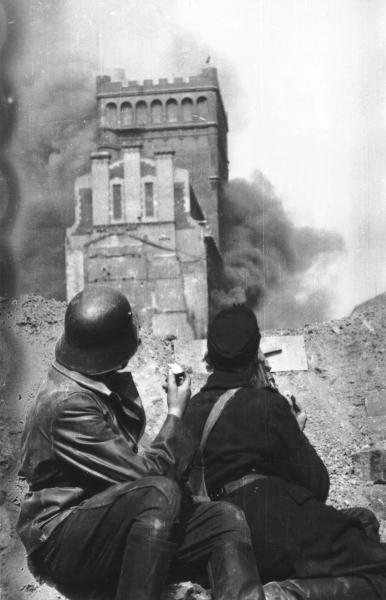
Battle for PAST telephone and telegraph exchange
PAST Building on fire during the battle
On 2nd
August 1944, a barricade was erected between no 9 and no 14 ul Prozna. No 14
was the headquarters of Kilinski battalion . Around the corner on ul Marszkalkowska
at the Past building were 130 German troops, the SS and police. No 14 was fortified and fierce
battles ensued with 36 German dead and 35 AK Polish soldiers. On 20th August
1944, the Past Building was captured by the Polish AK army. You can read more about ul Prozna in our blog The House with Faces here .
To give readers an idea of the
slaughter and destruction in Warsaw, to
the right of one of our offices is Hala Mirowska a food market.
Hala Mirowska
Here is an excerpt of a witness
to the atrocities which took place there against citizens.
"Central Commission for
Investigation of German Crimes in Poland."
Record No. 23 / II
“I found myself in a shelter
of the Ministry of Industry and Commerce, No. 2 Elektoralna Street. This was on
August 7, 1944.In the shelter there were
several hundred people, mostly women and children. In the afternoon of this
day, after the Insurgents had retreated from Elektoralna Street, a German
outpost was set in front of the gateway of the Ministry.
About 9 o’clock in the
evening 2 gendarmes entered the shelter and ordered all the men to go out. The
soldier who stood on guard assured us that we were only going to work. We were led out three by
three (we were about 150 men) to Mirowski Square, among the buildings of the
two Market Halls. Here we were ordered to remove the corpses, scores of which
were lying on the ground, and after that, rubble from the gutters and the
roadway. There were about a hundred
Poles on the square when we came, all busy cleaning it up, and some hundreds of
German gendarmes, who behaved very brutally: beating the Poles, kicking them,
and calling them Polnische Banditen.
At a certain moment they
stopped our work and ordered those who were not Poles to step forward. One man
who had White-Russian documents did so, and was released. After an hour and a half’s
work, the gendarmes ordered us to form threes. I found myself in the second
rank. We were all made to stand with our hands up.
An old man in the front rank,
who could not hold his hands up any longer, was cruelly struck in the face by a
gendarme.
After 10 minutes five rows of
three were marched off under the escort of five gendarmes armed with tommy guns
to the Market Hall in Chlodna Street. By chance I heard the names of two of the
gendarmes who shouted to each other, Lipinski and Walter.
When we entered the building
after passing two gates I saw, almost in the centre of the Hall, a deep hole in
which a fire was burning; it must have been sprinkled with petrol because of
the dense black smoke. We were put under a wall on the left side of the
entrance near a lavatory. We stood separately with faces turned to the wall and
hands up.
Plaque reads 7/8th August 1944 Nazis shot 510 Poles here at Hala Mirowska
After a few minutes I heard a
series of shots and I fell. Lying on the ground I heard the moans and groans of
people lying close to me and also more shots. When the firing ceased I heard
the gendarmes counting those who lay on the ground. Then they began to look for
two more who were missing. They found a father and son hiding in the adjoining
lavatory.They brought them out, and I
heard the voice of the boy shouting "Long live Poland, and then
shots and moans.
Some time later I heard the
voices of approaching Poles; cautiously I lifted my head and saw the gendarmes
standing beside the hole filled with fire and Poles carrying the corpses and
throwing them into it. Their work brought them nearer to me. I then crept into
the lavatory and concealed myself behind a partition which formed the roof of
the lavatory. Sitting there I heard firing near by and the shouts of Germans
from the direction of the hole.
At a certain moment another
Pole who had escaped from below through the lavatory found himself beside me.
He was Dr Jerzy Łakota, who worked in the Child Jesus Hospital.
We sat up there for many
hours. The whole time we heard the crackling of the burning corpses in the hole and of the fire itself.”
Many such atrocities
happened all over the city, the two incidents mentioned happened in a
small area in the city centre no more than 5 minutes walk apart.
This photo is a 3D modern reconstruction of Warsaw after the uprising
3D reconstruction of Warsaw after the Uprising
Despite the slaughter and
destruction, Warsaw was rebuilt, it survived the attempt to wipe it off the
map, it struggled to rebuild itself through 50 years of communism.
Today it stands testament to
those brave citizens of Warsaw, and Poland’s AK army, who gave their lives as the capital
of a free democratic Poland.
A vibrant. working. modern. city
changing quickly, developing, growing and expanding, reborn and standing tall to prove those who tried to destroy it did not win.
We are proud of our families, staff, our presence here, Warsaw our home, and our connection with Warsaw, it's citizens and of our clients who are rebuilding it, developing it and conserving monuments.
Warsaw not bowed, but a living bustling, working capital city of Poland an EU member.
On 1st August
every year people in Warsaw remember the fallen and the battle by flying the Polish flag, and not at half mast but flying proudly to commemorate the battle for the city,