
70th Anniversary of The Warsaw Uprising
1st August 2014
1st August 2014

1st of August is a special day in the hearts of
all Warsovians, and the Polish people,
it marks the start of the Warsaw Uprising in WW2.
it marks the start of the Warsaw Uprising in WW2.
It is a day for remembering heroes who fell, a day for
remembering heroes who took part, who are still with us. For remembering people who escaped
from concentration camps and ran to Warsaw to fight, and who dedicated their
lives to ensuring the nightmare of the occupation, concentration camps and
ghetto annihilation were never forgotten.
The day a nation remembers the 200,000 plus civilians
who died during Nazi reprisals for the uprising.
who died during Nazi reprisals for the uprising.
 |
| Polish AK army soldiers occupy the centre |
This year is the 70th Anniversary of The Warsaw
Uprising, for many outside Poland, the extent of what occurred, and why and the atrocities which
took place as a reprisal by German forces in the city is not commonly known.

Our office sits in the heart of Warsaw, in the former Jewish
ghetto, as we walk to work and meetings we pass many sites where Polish
soliders fought the Nazi occupiers to regain control of their capital city. The
memory plaques on the walls and bullet holes in old buildings testimony to the
city wide battle that took place in 1944 .
 |
| "Place where the blood of Poles was spilt defending their country" and "510 Poles executed here" |
At the end
of July of 1944, Poland is in its fifth year of German occupation. On the
eastern front, the German army is in full retreat suffering from the Red Army's
spring offensive which is approaching Warsaw's eastern suburbs.
 |
| General "Bor" Komorowski of AK |
The liberation
of Poland's capital seems to be within reach. General 'Bor' Komorowski, commander of the Polish Underground Home Army
(Armia Krajowa, AK), set the beginning of the uprising in Warsaw against the
German occupying forces at 'W-hour' - 5:00 p.m. on August 1, 1944.
The uprising was
expected to last about a week and to be a mopping up and disarming operation. The
insurgents, however, were unaware that the Germans have decided to defend
'fortress' Warsaw and to counter-attack Red Army forces to the east of the
city.
Warsaw's insurgents an estimated 40,000 soldiers, including 4,000 women, had only enough weapons for 2,500 fighters. They faced a 15,000-strong
German garrison which grew to a force of 30,000, armed with tanks, planes,
and artillery.
 |
| Women, teens, boy scouts in Polish AK army |
Women, children, youth fought in the AK Polish army, stood
on the barricades, walked through sewers to get to battle areas or escape,
nannies delivering arms from prams as they walked innocently around the city.
At hour W the alarm sounded for the start of the uprising,
ordered by the Polish government in exile in London. The Russian red army sat
on the other bank of the River Vistula, and did nothing to support the AK army.
 |
| Manning the barricades in centre of Warsaw |
Russia denied its allies Britain and USA the right to use their airfields to
drop supplies to the Polish troops fighting in the streets hand to hand, room
to room.
The British airforce flying from Italy dropped supplies yet suffered
heavy losses doing so.
The uprising and battle for Warsaw lasted 63 days, as
revenge for the uprising Hitler ordered Warsaw to be levelled, all occupants to
be executed, no prisoners to be taken , to set an example of horrific
proportions as a warning to the rest of occupied Europe.
 |
| Warsaw in ruins after the uprising reprisals |
Those buildings not
blown up by artillery fire, or by bombed from aircraft were blown up.
 |
| Citizens being evacuated, sadly most likely to be executed |
Reprisals
against Warsaw residents began with mass executions.
It is estimated 16000
Polish soldiers were killed and 200,000 Warsovians executed by the German
occupying Nazi forces.
Looting of the city prior to its destruction by the German
army was on an unprecedented level.
Delegations
from German municipalities were allowed to enter the ruins and strip them of
anything that had not already been taken by the Wehrmacht, and SS.
Postwar Polish assessments claim that 33,000 railway wagons filled with
furniture, personal belongings and factory equipment left Warsaw.
 |
| A boy sits amidst the ruins of his home alone with nothing left |
After everything of value was carried away, entire blocks of abandoned
houses were set on fire. Monuments and government buildings were blown up by
special German troops known as Verbrennungs und Vernichtungskommando
(burning and destruction detachments).
The executions were worst in Wola borough, where our office stands.
Hospitals, schools, flats, shops businesses, set on fire with flamethrowers,
grenade thrown in to open windows, escaping women and children shot.
On every
street corner, plaques commemorate those, raped then executed, shot, set alight
or blown up. Children were thrown in to burning buildings after witnessing their
mothers being shot, people were executed at the roadside.
 |
| Plaque commemorating the Hala Mirowska massacre with bullet holes in the wall |
In two days 65,000 civilians died in the Wola massacre at the hands of
the SS, and units of Belarussian and Ukrainian Nazis
To give the reader, an insight in to the extent of the horror, I have
picked one execution site in Mirow, bordering on Wola and in Mirow the Ghetto area.
 |
| Hala Mirowska today |
Hala Mirowska, Warsaw’s central food market, hides a grim grisly secret
yet is now a tourist attraction, and place where many people shop.
Between the 7th and 8th of August 1944 700 people
were executed in Hala Mirowska, with Nazi troops bringing corpses from
surrounding streets to be dumped in a huge pit inside the market to be burned.
 |
| Hala Mirowska during Nazi occupation |
If we walked West from Hala Mirowska 500 meters, we would pass execution sites
where deaths totalled 7000 alone.
 |
| Hala Mirowska burns in the uprising and Wola massacre |
Witness testimony from Nuremberg Trials
Executions
at Market Halls (Hala Mirowska)
Record No. 23 / II
During the Rising, on leaving the house where I lived, No. 30 Ogrodowa Street, I found myself in a shelter of the Ministry of Industry and Commerce, at No. 2 Elektoralna Street. This was on August 7, 1944.
In the shelter there were
several hundred people, mostly women and children. In the afternoon of this
day, after the Insurgents had retreated from Elektoralna Street, a German
outpost was set in front of the gateway of the Ministry. About 9 o’clock in the
evening 2 gendarmes entered the shelter and ordered all the men to go out. The
soldier who stood on guard assured us that we were only going to work. We were
led out three by three (we were about 150 men) to Mirowski Square, among the
buildings of the two Market Halls.
Here we were ordered to remove the corpses,
scores of which were lying on the ground, and after that, rubble from the
gutters and the roadway. There were about a hundred Poles on the square when we
came, all busy cleaning it up, and some hundreds of German gendarmes, who
behaved very brutally: beating the Poles, kicking them, and calling them
Polnische Banditen.
At a certain moment they stopped our work and ordered those
who were not Poles to step forward. One man who had White-Russian documents did
so, and was immediately released.
After an hour and a half’s work, the gendarmes ordered us to form
threes. I found myself in the second rank. We were all made to stand with our
hands up. An old man in the front rank, who could not hold his hands up any
longer, was cruelly struck in the face by a gendarme.
After 10 minutes five
rows of three were marched off under the escort of five gendarmes armed with
tommy guns to the Market Hall in Chlodna Street. By chance I heard the names of
two of the gendarmes who shouted to each other, Lipinski and Walter.
When we entered the building after passing two gates I saw, almost in
the centre of the Hall, a deep hole in which a fire was burning; it must have
been sprinkled with petrol because of the dense black smoke. We were put under
a wall on the left side of the entrance near a lavatory.
We stood separately
with faces turned to the wall and hands up.
After a few minutes I heard a series of shots and I fell. Lying on the
ground I heard the moans and groans of people lying close to me and also more
shots. When the firing ceased I heard the gendarmes counting those who lay on
the ground; they only counted up to thirteen.
Then they began to look for two
more who were missing. They found a father and son hiding in the adjoining
lavatory. They brought them out, and I heard the voice of the boy shouting
"Long live Poland", and then shots and moans.
 |
| Polish flag flying on 1st August near Hala Mirowska |
Sometime later I heard
the voices of approaching Poles; cautiously I lifted my head and saw the
gendarmes standing beside the hole filled with fire and Poles carrying the
corpses and throwing them into it. Their work brought them nearer to me. I then
crept into the lavatory and concealed myself behind a partition which formed
the roof of the lavatory. Sitting there I heard firing nearby and the shouts of
Germans from the direction of the hole.
At a certain moment another Pole who
had escaped from below through the lavatory found himself beside me. He was
doctor Jerzy Łakota, who worked in the Child Jesus Hospital.
We sat up there for many hours.
The whole time we heard the crackling of
the burning corpses in the hole and of the fire itself. Besides, we heard
series of shots coming from the other side (nearer to Zimna Street).
Dr. Lakota
told me that after a volley he had fallen along with the others. The gendarmes
came over to see if he was still alive, and beat him brutally; but he pretended
to be dead. I might add that when I fell after the volley, I saw a gendarme
examining those lying on the ground; those who were still alive he shot with
his revolver.
I had succeeded in escaping before this. At about 2 o’clock in
the night we descended and went out into the street through the already empty
Hall, in which the fire was still burning, and succeeded in getting to Krochmalna
Street.
 |
| Warsaw uprising symbol grafitti - it says "We Remember" |
Record No. 33 / II
On August 7, 1944, I was in the cellar of a house in Elektoralna Street in Warsaw. This day, at dusk, some German soldiers arrived on the premises and ordered all men to get out of the cellar, and to dismantle the barricades within two hours.
I obeyed and went out of the cellar with about fifty other
men. The soldiers took us under escort to Zelazna Brama Square, and then to the
place near Mirowska Street which is opposite the small square between the two
Market Halls. On the pavement of Mirowska Street there lay about 20 dead.
We were ordered to carry these corpses from the pavement of Mirowska
Street to the little square between the Halls. With other men I carried the
corpses and noticed while doing so that all of them were of more or less
middle-aged men.
After carrying these corpses we were ordered to remove the
barricade which was across the tram line from Zelazna Brama Square to Zelazna
Street. Having removed part of this barricade and thus enabled tanks to pass,
we were brought in the direction of Zelazna Street, where we were halted, and
ordered to put up our hands.
We were asked several times if there were no Volks-or Reichsdeutsche
among us . Next we were searched; everything of value, such as rings, watches
and cigarettes, was taken from us. After being searched we were left standing
on the same spot for about an hour and a half.
Not far from us were groups of
soldiers, in all about 200 men; our prayers for release were answered by the
soldiers with laughter and derision. They spoke German , Russian land
Ukrainian. One of them told us repeatedly that we should be killed at any
moment.
 |
| Warsaw burns |
Then (we were standing in rows of three) the first three rows were
driven into the Market Hall which is nearer to Zelazna Street. Shortly
afterwards I heard a series of shots. Then followed the next three rows. I was
in the second, or perhaps in the centre of the third.
At the moment when we
were directly in front of the entrance, one of the soldiers who was escorting
us fired, and instantly my neighbour on the left fell to the ground before me,
blocking my way; I stumbled and fell, but got up immediately and rejoined my
companions. I did not notice what happened to the body over which I had
stumbled.
After rising, when I reached my companions, who were then entering the
hall by the second inside gate, I saw a door leading to the right and
immediately ran through it. I saw a hall, entered it, and noticed stairs
leading upwards. It was already dark, but the darkness was lighted up by the
reflection of the fire all round me. I thought my escape had been observed,
as I heard a shout behind me, but no shots were fired. I ran to a gallery where
some of the wooden structure was burning and there I stayed.
During that time I heard separate shots from the interior of the hall.
After some time, I looked down from the gallery into the Hall and saw a big
round hole, about 6-7 metres (22 feet) across, in the floor of the Hall. In
this hole a big fire was burning; its flames rose several metres above the
level of the floor. I also noticed that the soldiers were leading a man to the
edge of the hole. I saw this man making the sign of the Cross, and then I heard
a shot, and saw him fall into the fire.
I might add that this shot was fired in
such a way that the soldier put his gun to the man’s neck and fired. Later I
saw many such scenes. I noticed that when the shot was fired the man did not
fall at once, but only after a few seconds.
Having watched several murders of this kind I could not look any more,
but heard many more shots and moans, which grew weaker and weaker, or even
human howls. I supposed that they came from those who had fallen into the fire
and were still alive.
 |
| German troops used flamethrowers to flush out civilians then shot them or threw them back in the burning building |
From the number of shots I took the impression that all those who had
been brought with me from the cellar of No. 2, Elektoralna Street were shot. I
stayed up in the gallery for some time longer (at least an hour), till the
moment the shooting and voices stopped. Then, unnoticed, I ran through the
Small Ghetto in the direction of Grzybowska Street, and afterwards came to
Zlota Street, where I stayed for a month.
Today Warsaw is alive and thriving, going through a renovation, bridges,
skyscrapers, offices, shopping centres, hotels and homes are being built along
with the second line of Warsaw’s metro.
 |
| The Past building in modern Warsaw where 130 AK soldiers lost their lives fighting to take the telephone exchange |
Amongst the modern capital stands a few remaining pre- war buildings,
some in ruins bombed out still, others renovated. People have re populated Wola
and The Ghetto, businesses, start ups and cafes, restaurants springing up to
renew Mirow and Wola’s trading and pavement cafe tradition.
 |
| Bombed out ruined pre war house, occupants and owners unknown all taken away |
The rebuilding and rebirth of Warsaw as Poland’s
capital city as a European city in an EU country and the activities Warsovian
busy themselves with daily, is great testimony to the Polish spirit of never
giving up.
 |
| Warsaw street cafe life reborn |
But for one day each year, the city remembers the
fallen, the heroes,
their actions and the survivors in a special way .
their actions and the survivors in a special way .
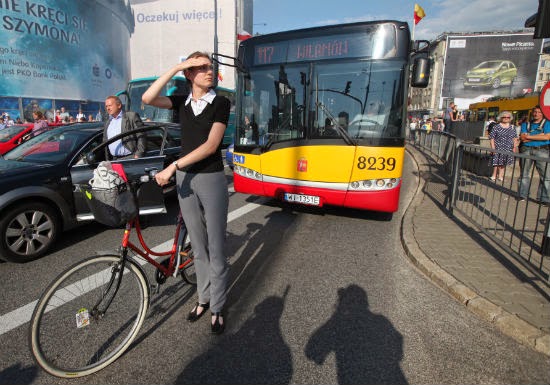 |
| Buses and Trams carry the yellow and red flag for Warsaw and Red and White Polish national flag on 1st August |
On Friday 1st August, the buses will fly
the city flags, plaques and memorials are cleaned especially, flowers lain in
memory. Residents fly the flag of Poland and the yellow and red flag of Warsaw
from their windows.
Ceremonies of remembrance will take place at
monument sites and at 1700, every church in Warsaw will ring its bells to mark
the occasions, the air raid sirens will sound to signal the W hour.
 |
| Remembrance service with President Komorowski and veteran survivors of the uprising |
Everyone will stand still, cars and buses, trams
will stop where they stand, shopping centres, offices and workers will stop and
stand in silence as a whole city remembers its fighters, heroes, dead and the
survivors .
 |
| Remembrance monument to child soldiers lost in the uprising |
Until 1989 commemorating the Warsaw uprising was forbidden
under communist rule, now we do this


